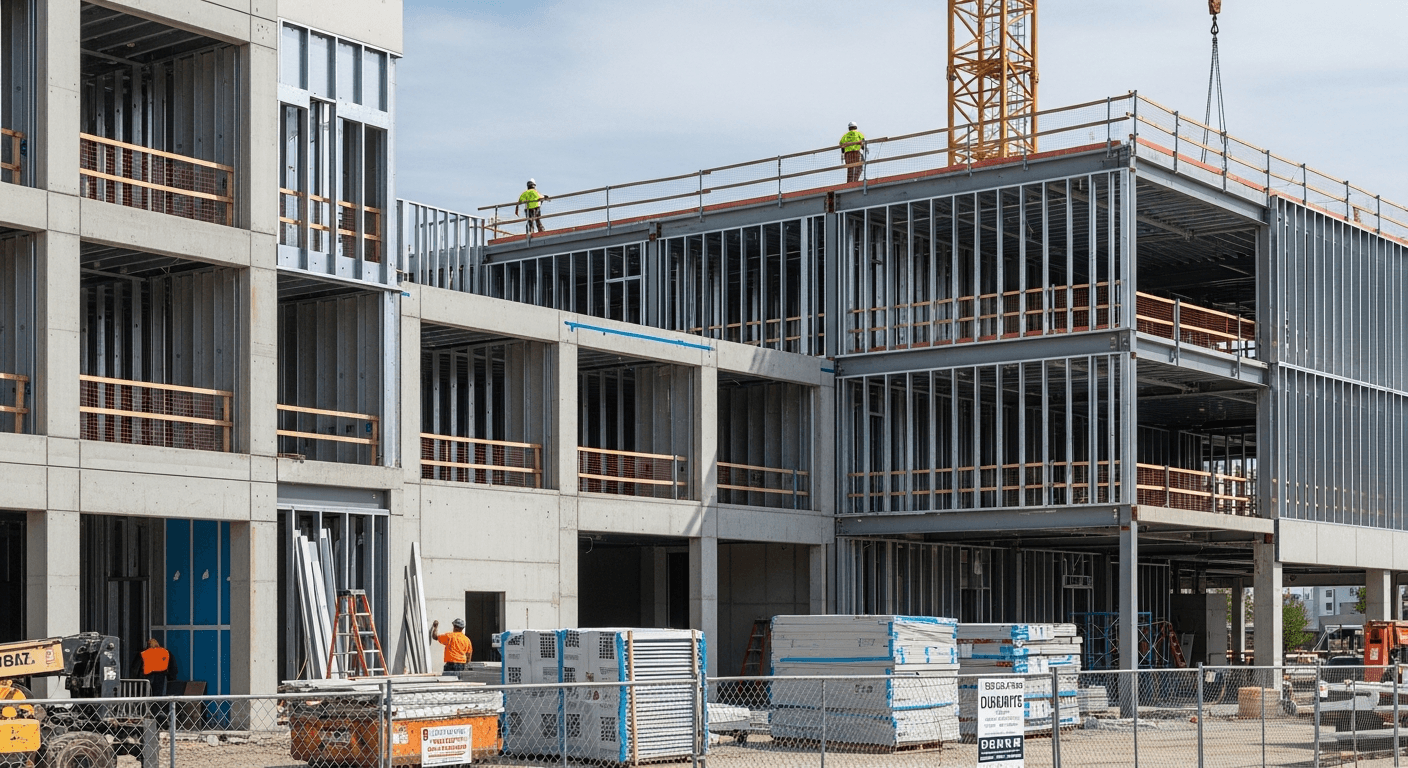
Urgent Care Construction in Charlotte: A Complete Guide for Medical Facility Developers
Charlotte's healthcare landscape is experiencing unprecedented growth, with urgent care facilities emerging as critical components of the region's medical infrastructure. The Charlotte metropolitan area has seen a 47% increase in urgent care centers since 2019, reflecting growing demand for immediate, convenient healthcare access. As the city's population approaches 2.8 million across the greater metro area, medical facility developers are increasingly focused on urgent care construction projects that meet both community needs and stringent regulatory requirements.
Building an urgent care facility in Charlotte requires specialized knowledge of medical construction standards, state health department regulations, and local building codes. Unlike traditional medical offices, urgent care centers demand specific spatial configurations, advanced mechanical systems, and rapid construction timelines to capture market opportunities. This comprehensive guide examines every aspect of urgent care construction in Charlotte, from pre-development planning through certificate of occupancy.
Understanding Urgent Care Facility Requirements in North Carolina
Urgent care facilities in North Carolina operate under distinct regulatory frameworks that differ significantly from traditional physician offices and emergency departments. The North Carolina Department of Health and Human Services requires specific licensing for urgent care centers, which directly impacts construction planning and design specifications for Charlotte-area projects.
Square Footage and Space Planning Considerations
Most urgent care facilities in Charlotte range from 3,500 to 6,000 square feet, with the optimal size typically falling around 4,200 square feet. This footprint accommodates the clinical and operational needs while maximizing efficiency in competitive markets like South End, Ballantyne, and Matthews.
Charlotte's most successful urgent care facilities position themselves within 3-5 miles of residential populations exceeding 40,000 residents, ensuring adequate patient volume for profitability.
Essential space allocation for Charlotte urgent care construction projects includes:
- Reception and waiting area: 600-800 square feet with seating for 12-16 patients
- Check-in and registration: 150-200 square feet
- 4-6 examination rooms: 100-120 square feet each
- 1-2 procedure rooms: 150-180 square feet each
- Laboratory and point-of-care testing area: 200-300 square feet
- Imaging room (X-ray): 250-300 square feet with lead-lined walls
- Medication and supply storage: 120-150 square feet
- Staff workspace and charting: 200-250 square feet
- Staff break room and restrooms: 150-200 square feet
- Clean and soiled utility rooms: 80-100 square feet each
Charlotte's diverse neighborhoods drive varying facility design approaches. Areas like Huntersville, Cornelius, and the Lake Norman region require larger waiting areas due to higher patient volumes, while suburban locations in Waxhaw, Indian Trail, and Rock Hill, SC can optimize space more efficiently due to predictable patient flow patterns.

Code Compliance and Regulatory Framework
Urgent care construction in Charlotte must comply with multiple regulatory layers. The North Carolina Building Code adopts the International Building Code (IBC) with state-specific amendments, classifying urgent care facilities as Business Group B occupancies with specific healthcare provisions.
Key code requirements for Charlotte urgent care construction include:
- Minimum corridor width of 8 feet in patient care areas (vs. 6 feet in general business occupancies)
- Fire-rated construction between patient care zones and non-clinical spaces
- Positive room pressure differentials in clean areas, negative pressure in soiled utility rooms
- Emergency power systems for critical circuits and exit lighting
- Infection control considerations including hands-free fixtures and non-porous surfaces
- ADA compliance exceeding standard commercial requirements, including accessible exam tables and imaging equipment positioning
The North Carolina State Building Code Section 407 specifically addresses medical facilities, requiring coordination with local health departments during plan review. Mecklenburg County Environmental Health reviews all plumbing and medical gas systems.
Site Selection and Due Diligence for Charlotte Urgent Care Projects
Site selection represents one of the most critical decisions in urgent care development throughout the Charlotte metropolitan area. The region's diverse geography and development patterns create distinct opportunities and challenges across different submarkets from Uptown Charlotte to the expanding corridors in Matthews, Pineville, and Fort Mill, SC.
Location Analysis and Market Positioning
Successful urgent care facilities in Charlotte typically occupy high-visibility locations with excellent access from major thoroughfares. Traffic counts of 25,000+ vehicles per day provide optimal visibility, while strategic positioning within Charlotte's growing suburbs ensures market capture.
Key location criteria for Charlotte urgent care construction projects include:
- Corner or end-cap positions in retail centers for maximum visibility
- Dedicated parking ratios of 1 space per 200-250 square feet (18-25 spaces for a 4,500 SF facility)
- Ground-floor access with covered entry drop-off zones
- Proximity to complementary retail including pharmacies (CVS, Walgreens) within 0.25 miles
- Distance from competing urgent care facilities (minimum 2-mile radius preferred)
- Access to municipal water and sewer infrastructure capable of handling medical waste requirements
Areas experiencing significant urgent care development include University City near UNC Charlotte, the rapidly growing Indian Trail and Waxhaw corridor, and the Lake Norman region spanning Huntersville, Cornelius, and Mooresville. These Charlotte-area markets combine population growth, favorable demographics, and strategic positioning relative to existing emergency department access.
Planning an urgent care facility in the Charlotte region? Our commercial construction team specializes in medical projects that meet all regulatory requirements while staying on schedule and budget.
Get a Free ConsultationZoning and Land Use Considerations
Charlotte's Unified Development Ordinance (UDO) governs land use and zoning throughout Mecklenburg County. Urgent care facilities typically fall under medical office classifications, with varying permissions across different zoning districts throughout the Charlotte metro area.
Permitted zoning districts for urgent care construction in Charlotte include:
- B-1 (Neighborhood Business): Permitted with restrictions on square footage
- B-2 (General Business): Permitted use with minimal restrictions
- TOD (Transit-Oriented Development): Encouraged use near LYNX light rail stations
- UR (Urban Residential): Conditional use requiring special approval
- MUDD (Mixed-Use Development District): Permitted in mixed-use projects
Surrounding Charlotte municipalities including Matthews, Pineville, Huntersville, and Mooresville maintain separate zoning ordinances. York County, SC, which encompasses Fort Mill, Rock Hill, and Tega Cay, operates under different regulatory frameworks requiring additional due diligence for urgent care construction projects across the state line.

Design and Engineering Requirements for Urgent Care Facilities
Urgent care construction demands specialized design approaches that differ substantially from standard commercial construction projects throughout Charlotte. The integration of clinical functionality with operational efficiency requires careful coordination among architects, engineers, and medical planners familiar with North Carolina healthcare regulations.
HVAC and Mechanical System Requirements
Medical facilities require sophisticated HVAC systems that exceed standard commercial specifications. North Carolina mechanical codes mandate specific air change rates and filtration standards that directly impact urgent care construction costs and complexity in Charlotte projects.
| Space Type | Air Changes Per Hour | Special Requirements |
|---|---|---|
| Examination rooms | 6 ACH minimum | MERV 13 filtration |
| Waiting areas | 6-8 ACH | Higher occupancy loads |
| Procedure rooms | 8-10 ACH | HEPA filtration options |
| X-ray rooms | 6 ACH | Isolated HVAC zones |
| Laboratory areas | 10-12 ACH | Negative pressure |
| Soiled utility | 10 ACH minimum | 100% exhaust, negative pressure |
Charlotte's humid subtropical climate creates additional HVAC challenges for urgent care construction. Summer temperatures regularly exceed 90°F with humidity levels above 70%, requiring systems designed for 20-25% oversizing compared to standard calculations. Dehumidification becomes critical for infection control and patient comfort, particularly in waiting areas during peak patient volumes.
Medical-grade HVAC systems for Charlotte urgent care construction typically cost $28-$42 per square foot, compared to $12-$18 per square foot for standard commercial systems.
Plumbing and Medical Gas Infrastructure
Urgent care facilities require specialized plumbing systems that support both standard facilities and medical functions. Charlotte's municipal water systems provide adequate pressure (60-80 psi typical), but medical gas systems require dedicated infrastructure installed by licensed medical gas contractors.
Key infrastructure components for urgent care construction in Charlotte include:
- Medical-grade compressed air systems for clinical equipment (typically 150-175 psi)
- Medical vacuum systems for suction applications in procedure rooms
- Oxygen delivery systems when respiratory care services are provided
- Hands-free fixtures throughout patient care areas (foot-pedal or sensor-activated)
- Emergency eyewash and safety shower stations in laboratory areas
- Hot water recirculation systems maintaining 110°F minimum at all fixtures
- Backflow prevention devices meeting ASSE 1013 standards
Electrical and Technology Infrastructure
Modern urgent care facilities operate as technology-intensive environments requiring robust electrical infrastructure throughout Charlotte projects. Power density calculations for urgent care average 8-12 watts per square foot, significantly higher than the 4-6 watts typical in general office spaces.
Critical electrical requirements for Charlotte urgent care construction include:
- Emergency power systems (generator or battery backup) serving life safety circuits, exit lighting, and critical medical equipment
- Isolated ground circuits for sensitive diagnostic equipment including digital X-ray systems
- Dedicated circuits for imaging equipment (typically 208V, 3-phase, 60-100 amps)
- Structured cabling supporting electronic health records (EHR) systems with Category 6A minimum specifications
- Wireless access point infrastructure with healthcare-grade security protocols
- Patient call systems and staff communication networks
- Security camera systems with HIPAA-compliant recording and storage
Duke Energy serves most of Charlotte and surrounding Mecklenburg County, while areas like Rock Hill operate under different utilities. Coordination with utility providers should begin during early design phases, as medical facilities may require service upgrades or transformer installations that extend urgent care construction project timelines by 8-12 weeks.

Construction Methodology and Project Delivery for Urgent Care Facilities
Time-to-market represents a critical factor in urgent care development throughout Charlotte's competitive healthcare market. Every month of delayed opening represents significant revenue loss, making construction efficiency paramount for projects from South Charlotte to Lake Norman and extending into South Carolina markets like Fort Mill and Rock Hill.
Construction Timeline and Phasing
Typical urgent care construction timelines in Charlotte range from 16-26 weeks from permit issuance to certificate of occupancy, depending on project complexity and existing conditions. Ground-up construction extends timelines to 32-44 weeks. Charlotte general contractors specializing in medical construction employ specific strategies to compress schedules while maintaining quality and compliance.
Pre-construction and Permitting
8-12 weeks for design development, permit submission, and approval. Charlotte-Mecklenburg planning review typically requires 6-8 weeks for commercial projects, with medical facilities often requiring additional health department coordination.
Demolition and Infrastructure
2-3 weeks for tenant improvement projects removing existing finishes and upgrading base building systems in Charlotte area properties.
Rough-in Construction
6-8 weeks installing HVAC, plumbing, electrical, and medical gas systems. This phase includes structural modifications, lead-lined wall installation for imaging rooms, and fire-rated assemblies.
Interior Finishes
4-6 weeks for drywall, painting, flooring, millwork, and finishes. Medical facilities require specialized materials including antimicrobial paint, sheet vinyl with heat-welded seams, and solid surface countertops.
Equipment and Technology
3-4 weeks for installing medical equipment, imaging systems, EHR infrastructure, and security systems. This phase overlaps with finish work in Charlotte urgent care projects.
Inspection and Commissioning
2-3 weeks for building inspections, medical gas testing, HVAC commissioning, and final health department approvals throughout the Charlotte metro area.
Cost Considerations and Budget Planning
Urgent care construction costs in Charlotte vary significantly based on project type, existing conditions, and finish quality. Current market conditions reflect the region's strong construction economy and competitive labor markets, particularly in high-demand areas like Ballantyne, SouthPark, and the University City corridor.
| Project Type | Cost per Square Foot | Typical Total Cost (4,500 SF) |
|---|---|---|
| Ground-up construction | $285-$375 | $1,282,500-$1,687,500 |
| Tenant improvement (shell space) | $185-$245 | $832,500-$1,102,500 |
| Renovation/conversion | $210-$285 | $945,000-$1,282,500 |
| Medical equipment and furnishings | $85-$125 | $382,500-$562,500 |
These ranges reflect Charlotte market conditions as of 2024, including labor costs averaging $45-$65 per hour for skilled trades and material premiums for medical-grade components. Projects in high-demand Charlotte areas like South End, Uptown, or Ballantyne may see 8-12% cost premiums due to site logistics and competitive labor markets.
Budget planning for Charlotte urgent care construction should account for several cost drivers unique to medical construction, including lead-lined walls ($32-$48/SF vs. $8-$12 for standard drywall), medical-grade HVAC systems (2.5-3.5x standard commercial costs), and antimicrobial finishes (25-40% premium).
Get accurate budget estimates for your Charlotte urgent care construction project. We provide detailed cost breakdowns based on current market conditions. Call (980) 471-1745
Get a Free Consultation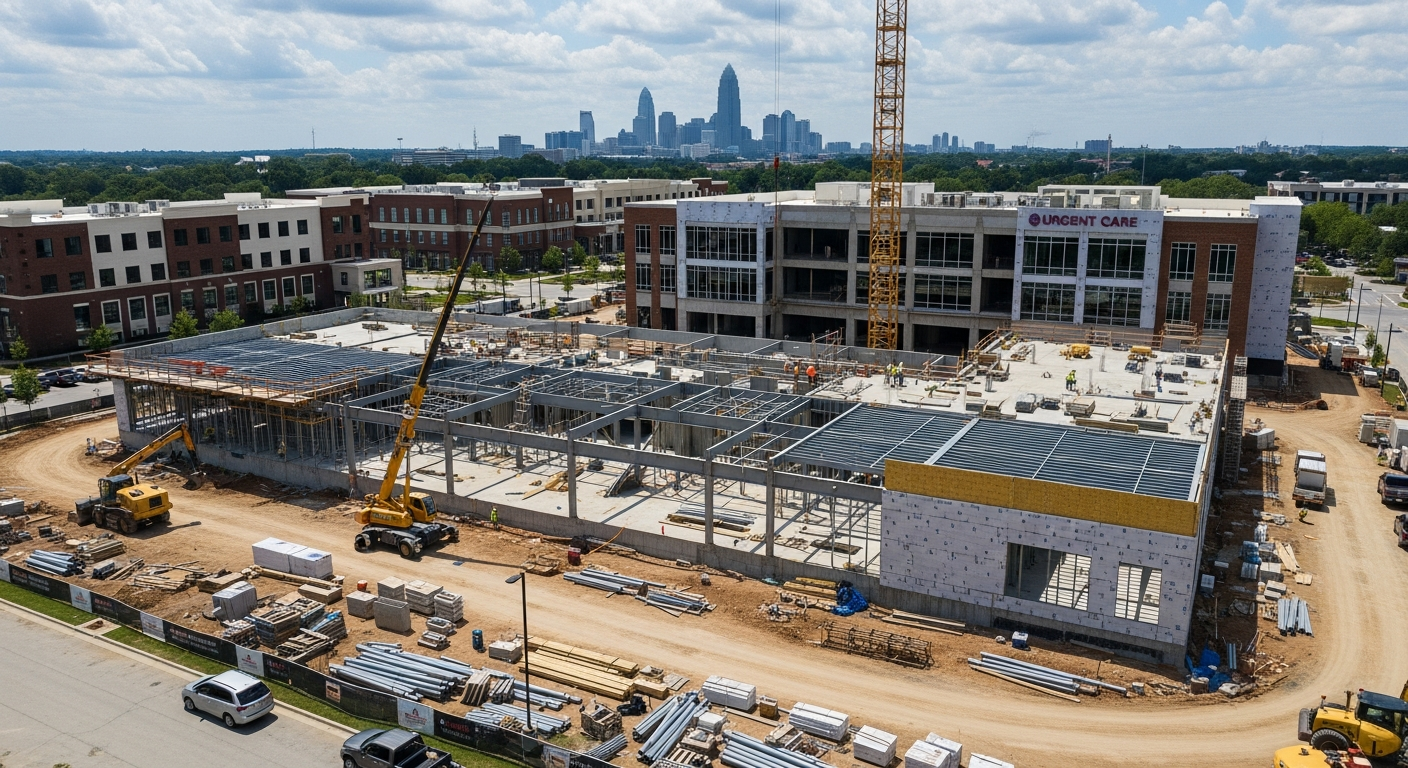
Tenant Improvement vs. Ground-Up Construction: Strategic Considerations
Charlotte's commercial real estate market offers multiple pathways for urgent care development. The choice between tenant improvement and ground-up construction significantly impacts timelines, costs, and long-term operational efficiency for projects throughout the Charlotte metropolitan area.
Advantages of Tenant Improvement Approach
Converting existing retail or office space represents the most common urgent care development strategy in Charlotte. Commercial upfit projects offer several advantages for urgent care construction:
Speed and Efficiency
- 16-22 weeks typical vs. 32-44 weeks for ground-up construction
- Faster market entry in competitive Charlotte submarkets
- Established infrastructure reduces site development costs
Financial Benefits
- 30-40% cost reduction compared to new construction
- Lower initial capital investment
- Lease flexibility for market testing
High-quality retail centers throughout Charlotte offer excellent tenant improvement opportunities for urgent care construction. Locations like Stonecrest at Piper Glen, Birkdale Village in Huntersville, Phillips Place in SouthPark, and Waverly in south Charlotte provide the visibility, parking, and demographics urgent care facilities require while existing infrastructure reduces development costs.
When Ground-Up Construction Makes Sense
Purpose-built urgent care facilities offer long-term advantages that justify higher initial investment in specific Charlotte market scenarios:
- Long-term market commitment: Ownership eliminates lease expenses and provides operational control in established Charlotte submarkets
- Optimized patient flow: Custom design creates ideal spatial relationships and operational efficiency
- Brand differentiation: Distinctive architecture enhances market positioning and brand recognition in competitive Charlotte markets
- Future expansion capability: Sites can accommodate additions as patient volume grows
- Advanced imaging integration: CT or MRI capabilities require structural design considerations difficult to retrofit
Ground-up urgent care construction excels in high-growth Charlotte corridors like the Highway 74 corridor through Matthews, Weddington, and Waxhaw, or the I-77 corridor north through Huntersville and Mooresville. These areas offer available land, strong population growth projections, and minimal existing urgent care competition.
Key Building Systems and Technology Integration
Modern urgent care facilities throughout Charlotte function as sophisticated technology platforms integrating clinical care delivery with operational management systems. Successful urgent care construction projects incorporate advanced building systems that support both immediate operational needs and future technological evolution.
Electronic Health Records and Network Infrastructure
EHR systems represent the operational backbone of urgent care facilities, requiring robust technology infrastructure throughout Charlotte projects. Charlotte's technology infrastructure supports advanced telemedicine integration, with 5G cellular coverage throughout most of the metro area enabling remote physician consultations and specialist referrals.
Critical considerations for urgent care construction technology infrastructure include:
- Redundant internet connectivity from diverse providers (Spectrum Business, AT&T Business, Verizon) with automatic failover
- Dedicated server rooms or data closets with HVAC systems maintaining 68-72°F with ±2°F tolerance
- Structured cabling exceeding minimum standards (Category 6A instead of Category 6) to support future bandwidth requirements
- Wireless networks with healthcare-grade security, supporting 20-30 concurrent devices per access point
- Voice over IP (VoIP) phone systems integrated with patient management platforms
- Uninterruptible power supply (UPS) systems protecting network equipment and servers during power interruptions
Security and Access Control Systems
Medical facilities face unique security challenges balancing open access for patients with controlled access to medication storage, equipment, and patient information. Charlotte's suburban expansion creates increasingly distributed patient populations, making security considerations vital for urgent care construction in lower-density areas where overnight security presence may be impractical.
Comprehensive security systems for Charlotte urgent care construction include:
- Card access control systems restricting employee-only areas while maintaining public access to patient zones
- CCTV surveillance with HIPAA-compliant recording (avoiding patient care areas where privacy expectations exist)
- Medication storage areas with dual authentication (card + PIN) and audit trail logging
- Panic button systems in reception, triage, and examination areas
- After-hours monitoring and alarm systems
- Visitor management systems tracking patient and guest access

Specialized Construction Considerations for Charlotte's Climate
Charlotte's climate presents specific challenges for urgent care construction throughout the metropolitan area. The region experiences hot, humid summers with average high temperatures of 89-91°F in July and August, combined with moderate winters averaging 50-52°F. This climate pattern drives several construction considerations unique to urgent care projects in the Charlotte region.
Building Envelope and Moisture Control
Humidity control represents perhaps the most critical climate-related consideration for Charlotte urgent care construction. Medical facilities cannot tolerate moisture problems that promote mold growth, compromise indoor air quality, or damage sensitive equipment throughout Charlotte's humid climate.
Best practices for urgent care construction in Charlotte include:
- Continuous air barriers preventing humid outdoor air infiltration into conditioned spaces
- Vapor retarders positioned on the warm-in-winter side of insulation assemblies
- Dedicated dehumidification systems supplementing standard HVAC equipment during shoulder seasons
- Proper flashing and water management at roof penetrations, windows, and wall transitions
- Condensate management systems for HVAC equipment including backup drains and overflow protection
Advanced roof coating systems provide additional moisture protection for existing buildings being converted to urgent care use throughout Charlotte. These systems restore aging commercial roofs while providing reflective properties that reduce cooling loads,a significant consideration given Charlotte's summer heat and the elevated cooling requirements of medical facilities.
Energy Efficiency and Sustainability
While urgent care facilities consume significantly more energy than typical commercial spaces (60-80 kBTU per square foot annually versus 40-50 for standard offices), Charlotte urgent care construction projects increasingly incorporate energy-efficient strategies.
As a member of the U.S. Green Building Council, our approach to Charlotte urgent care construction incorporates sustainable building practices that reduce operating costs while maintaining the rigorous environmental controls medical facilities require.
Energy-efficient strategies for Charlotte urgent care construction include:
- High-efficiency HVAC systems with economizer cycles capitalizing on cooler outdoor air during moderate weather
- LED lighting throughout with occupancy sensors in support spaces reducing unnecessary operation
- High-performance glazing (U-factor 0.30 or better) minimizing solar heat gain in waiting areas with exterior windows
- Cool roof systems (TPO or PVC single-ply membranes) with solar reflectance index (SRI) above 78
- Energy recovery ventilators (ERV) reclaiming energy from exhaust air to precondition incoming ventilation
- Building automation systems optimizing HVAC operation during unoccupied hours
Permitting and Regulatory Approval Process in Charlotte
Navigating Charlotte's regulatory environment represents a critical success factor for urgent care construction projects. The approval process involves multiple agencies operating on different timelines with distinct requirements throughout the Charlotte metropolitan area.
Local Building Permit Process
Charlotte-Mecklenburg's Code Enforcement division manages building permits for most of the metro area. The urgent care construction permit process includes several coordinated stages:
Pre-submittal Conference
Optional but recommended meeting with Charlotte plan reviewers to identify potential issues before formal submission of urgent care construction documents.
Permit Application
Complete construction documents including architectural, structural, mechanical, electrical, and plumbing plans specific to urgent care requirements.
Plan Review
6-8 weeks for initial review, with additional time for revisions if deficiencies are identified in urgent care construction plans.
Permit Issuance
Following plan approval and fee payment, permits are issued authorizing urgent care construction throughout Charlotte.
Inspection Sequence
Footings/foundation (if applicable), rough-in (framing, MEP), fire-rated assemblies, final inspection for Charlotte urgent care projects.
Certificate of Occupancy
Issued following successful final inspection and verification of all corrections for urgent care facilities.
Surrounding municipalities maintain separate processes for urgent care construction. Matthews, Huntersville, and Cornelius operate independent building departments with comparable timelines but different fee structures and review protocols. Projects in unincorporated Mecklenburg County areas follow county procedures, while South Carolina urgent care construction in Fort Mill, Rock Hill, or Tega Cay requires coordination with respective municipal building departments and York County offices.
Health Department and State Agency Approvals
Medical facilities require additional approvals beyond standard building permits for urgent care construction throughout Charlotte. The North Carolina Division of Health Service Regulation oversees clinical aspects through several mechanisms:
- Medical facility plan review: Clinical space design must be submitted to DHSR for approval before urgent care construction begins
- Equipment installation approval: X-ray equipment requires registration with the Radiation Protection Section before operation
- Environmental health review: Mecklenburg County Environmental Health reviews and approves plumbing, medical gas systems, and infection control measures for Charlotte urgent care projects
- License to operate: Separate from building permits, urgent care facilities must obtain appropriate licensure before patient care begins
Building permits can be issued while health department reviews are underway, but urgent care construction cannot proceed in areas affecting clinical spaces until all approvals are secured. Effective coordination reduces total approval time by 3-5 weeks.
Selecting the Right Construction Partner for Your Charlotte Urgent Care Project
The complexity of urgent care construction demands contractors with specific medical facility experience throughout Charlotte. Not all commercial contractors possess the specialized knowledge required for successful medical project delivery in Charlotte's competitive healthcare market.
Relevant Experience and Track Record
Contractors should demonstrate proven experience with medical facility construction, particularly urgent care projects throughout Charlotte and surrounding areas. Critical capabilities for urgent care construction include:
- Understanding of medical facility building codes and compliance requirements
- Relationships with specialized subcontractors including medical gas installers, imaging equipment vendors, and medical-grade HVAC contractors
- Experience coordinating health department approvals and medical equipment installations
- Knowledge of infection control protocols during construction in occupied medical buildings
- Familiarity with Charlotte's regulatory environment and approval processes
Review contractors' project portfolios carefully, seeking urgent care construction projects similar in scope, budget, and complexity to your Charlotte development. References from previous medical facility clients provide valuable insights into contractors' performance, problem-solving abilities, and collaboration approaches for urgent care projects.
Project Delivery Methodology
Construction delivery method significantly impacts urgent care construction project success throughout Charlotte. Three primary approaches serve urgent care development:
Design-Bid-Build
Traditional sequential process where design completes before contractor selection. Provides cost certainty but extends timelines. Best for straightforward urgent care projects with well-defined scopes.
Design-Build
Single entity responsible for both design and construction. Accelerates timelines through overlapping design and construction phases. Ideal for fast-track urgent care projects in competitive Charlotte markets.
Charlotte's competitive urgent care market often favors design-build delivery, compressing construction timelines by 4-8 weeks through concurrent design and permitting activities. However, this approach requires contractors with strong design capabilities and medical facility expertise to avoid costly revisions during urgent care construction.
Communication and Project Management
Medical facility construction involves numerous stakeholders including developers, operators, architects, engineers, equipment vendors, and regulatory agencies. Effective contractors demonstrate strong project management capabilities for Charlotte urgent care construction:
- Dedicated project managers and superintendents assigned throughout urgent care construction
- Regular progress meetings with documented action items and accountability
- Transparent budget tracking with detailed cost breakdowns and change order documentation
- Proactive problem identification and solution development
- Coordination with medical equipment vendors and technology installers
- Clear communication channels for quick decision-making
Charlotte's distributed geography means contractors must efficiently manage urgent care construction projects across the metro area from South Charlotte to Lake Norman, maintaining consistent quality and communication regardless of project location. Teams familiar with specific Charlotte submarkets understand local permit processes, utility coordination requirements, and inspection protocols that impact urgent care construction schedules.
Ready to start your Charlotte urgent care construction project? Our experienced team understands the unique requirements of medical facility development.
Schedule a Free ConsultationPost-Construction Considerations: Commissioning and Startup
Successful urgent care construction projects extend beyond certificate of occupancy issuance throughout Charlotte. The transition from construction to operations requires careful planning and systematic execution for urgent care facilities to achieve operational readiness.
Building Systems Commissioning
Medical facilities demand rigorous commissioning verifying all systems perform as designed. North Carolina requires specific commissioning documentation for medical gas systems and imaging equipment before urgent care facilities can obtain operating licenses throughout Charlotte.
Critical commissioning activities for Charlotte urgent care construction include:
- HVAC system testing: Verification of air change rates, pressure relationships, temperature control, and humidity management across all zones
- Medical gas certification: Pressure testing, purity verification, and flow testing of compressed air, vacuum, and oxygen systems per NFPA 99
- Electrical system verification: Testing of emergency power systems, ground fault monitoring, and isolated ground circuits
- Plumbing system testing: Hot water temperature verification, backflow prevention testing, and drainage system inspection
- Fire and life safety: Testing of fire alarm systems, sprinkler systems, emergency lighting, and exit signage
- Technology infrastructure: Network performance testing, wireless coverage verification, and EHR system integration
Staff Training and Facility Familiarization
Operational readiness requires clinical and administrative staff understand facility systems and equipment. Charlotte's competitive healthcare market makes rapid startup critical for urgent care facilities. Facilities that transition smoothly from construction to operations capture market share faster, achieving positive cash flow 4-6 weeks earlier than projects experiencing startup difficulties.
Effective urgent care construction contractors provide:
- Comprehensive operations and maintenance manuals for all building systems
- Training sessions on HVAC controls, security systems, and building automation
- Demonstration of emergency procedures including power failures and system malfunctions
- Documentation of equipment warranties and service requirements
- Contact information for equipment vendors and service providers
Future-Proofing Your Charlotte Urgent Care Facility
Healthcare delivery continues evolving rapidly, with telehealth integration, advanced diagnostics, and changing reimbursement models reshaping urgent care operations throughout Charlotte. Forward-thinking urgent care construction approaches accommodate future needs while maximizing current operational efficiency.
Flexible Space Design for Urgent Care Construction
Design urgent care spaces throughout Charlotte to accommodate evolving clinical models:
- Modular examination room layouts allowing conversion between standard exam rooms and procedure rooms
- Oversized electrical rooms and data closets accommodating future technology upgrades
- Chase walls providing pathways for future cabling and piping without invasive renovations
- Structural capacity for future imaging equipment upgrades (CT scanners, advanced ultrasound)
- Expansion capability through strategic site planning and utility sizing
Technology Infrastructure Planning
Invest in urgent care construction technology infrastructure exceeding immediate requirements throughout Charlotte:
- Fiber optic backbone cabling supporting future bandwidth requirements
- Conduit systems allowing technology additions without ceiling or wall penetrations
- Electrical panel capacity 25-30% above initial loads to accommodate future equipment
- Dedicated server room space with expansion capability
- Redundant utility feeds supporting critical operations
Key Takeaways for Charlotte Urgent Care Construction
- Charlotte's urgent care market has grown 47% since 2019, creating significant development opportunities
- Optimal facility size ranges from 3,500-6,000 square feet, with 4,200 SF providing ideal operational efficiency
- Construction timelines range from 16-26 weeks for tenant improvements, 32-44 weeks for ground-up construction
- Total project costs range from $185-$375 per square foot depending on project type and complexity
- Site selection requires high visibility locations with 25,000+ daily traffic counts within 3-5 miles of 40,000+ residents
- Medical-grade HVAC, electrical, and technology systems require specialized contractors familiar with healthcare regulations
- Multi-agency approval processes require coordinated project management and regulatory expertise
Frequently Asked Questions About Urgent Care Construction in Charlotte
How long does urgent care construction take in Charlotte?
Urgent care construction timelines in Charlotte typically range from 16-26 weeks for tenant improvement projects and 32-44 weeks for ground-up construction. Factors affecting timeline include permit approval processes, project complexity, existing building conditions, and contractor experience with medical facilities.
What are the typical costs for urgent care construction in Charlotte?
Urgent care construction costs in Charlotte range from $185-$245 per square foot for tenant improvements and $285-$375 per square foot for ground-up construction. A typical 4,500 square foot facility costs between $832,500-$1,687,500 depending on project type, finishes, and site conditions.
What permits are required for urgent care construction in Charlotte?
Urgent care construction in Charlotte requires building permits from Charlotte-Mecklenburg Code Enforcement, health department approvals from Mecklenburg County Environmental Health, medical facility plan review from North Carolina DHSR, and equipment registration for X-ray systems with the state Radiation Protection Section.
How much space is needed for an urgent care facility in Charlotte?
Most successful urgent care facilities in Charlotte range from 3,500-6,000 square feet, with 4,200 square feet representing the optimal size for operational efficiency. Space allocation includes 4-6 exam rooms, 1-2 procedure rooms, laboratory, X-ray room, and support spaces.
What are the key location criteria for urgent care facilities in Charlotte?
Successful urgent care locations in Charlotte require high visibility with 25,000+ daily traffic counts, proximity to 40,000+ residents within 3-5 miles, adequate parking (18-25 spaces), ground-floor access, and distance from competing facilities. Areas like South Charlotte, Lake Norman, and Matthews offer optimal demographics.
Do urgent care facilities require specialized HVAC systems in Charlotte?
Yes, urgent care facilities require medical-grade HVAC systems with specific air change rates (6-12 ACH depending on space type), MERV 13+ filtration, pressure relationships, and enhanced humidity control due to Charlotte's humid climate. These systems cost 2.5-3.5 times standard commercial HVAC.
What makes urgent care construction different from standard commercial construction?
Urgent care construction requires specialized building systems (medical gas, advanced HVAC), regulatory approvals from health departments, infection control measures, lead-lined walls for imaging, and medical-grade finishes. Construction must comply with healthcare codes exceeding standard commercial requirements.
Can existing retail or office space be converted to urgent care in Charlotte?
Yes, tenant improvement projects represent the most common urgent care development approach in Charlotte. Existing retail or office spaces can be successfully converted, typically reducing costs by 30-40% and accelerating timelines by 12-18 weeks compared to ground-up construction while maintaining full regulatory compliance.