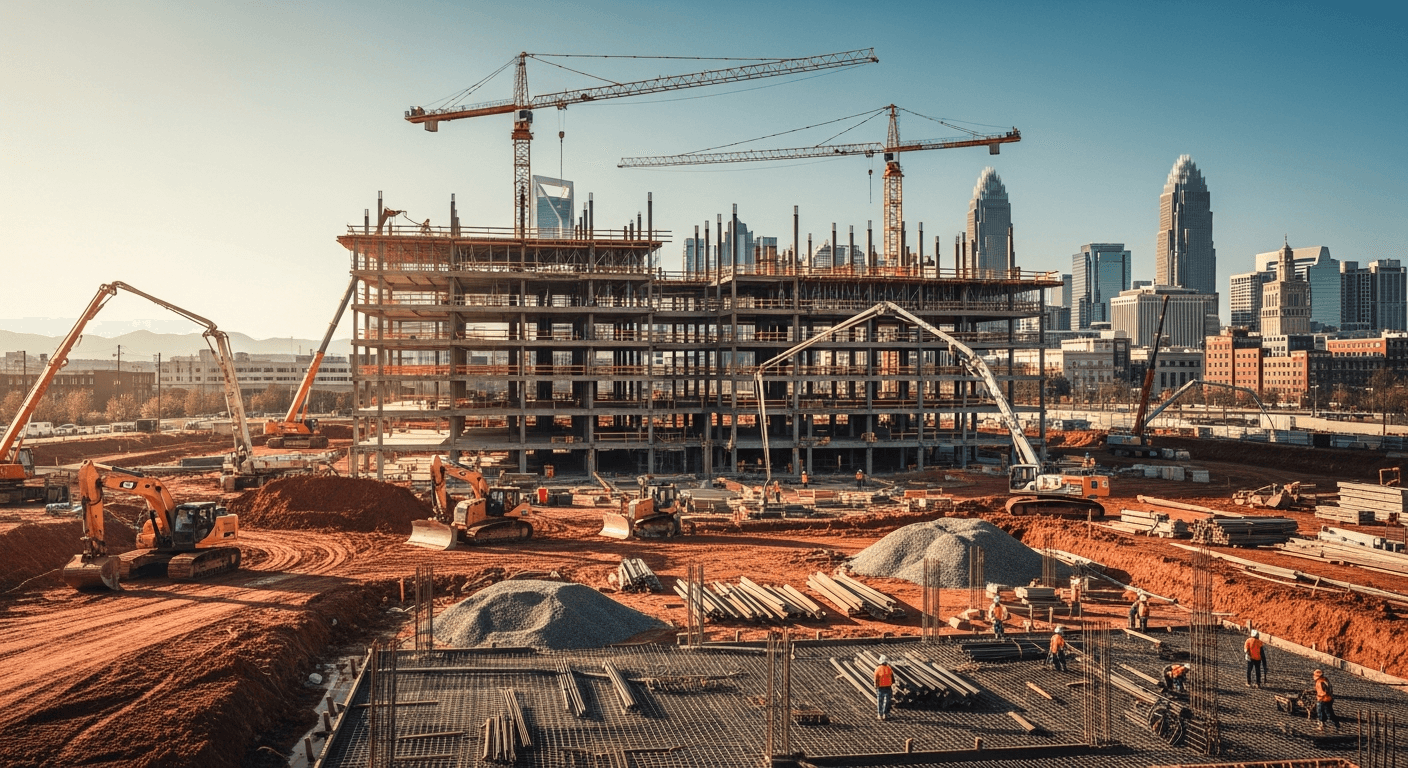
Charlotte Construction Costs Per Square Foot 2026: Complete Commercial Pricing Guide
Charlotte construction costs per square foot in 2026 range from $150 to $450 depending on building type, with office construction averaging $210-$425, warehouse facilities $85-$275, and retail projects $165-$525 per square foot. As Charlotte continues its evolution as the second-largest financial center in the United States, understanding current construction cost benchmarks is essential for accurate project budgeting and feasibility analysis.
As a general contractor serving Charlotte and surrounding areas including Ballantyne, Huntersville, and Rock Hill SC, we've observed significant shifts in construction pricing throughout 2025 and into 2026. Material costs have stabilized after the volatility of 2021-2023, but labor shortages and increased code requirements continue to influence per-square-foot pricing across all commercial project types.
This comprehensive guide breaks down exactly what property owners and developers can expect to pay for various commercial construction projects in Charlotte and the surrounding metropolitan area in 2026, including detailed cost factors, regional variations, and strategic planning considerations.
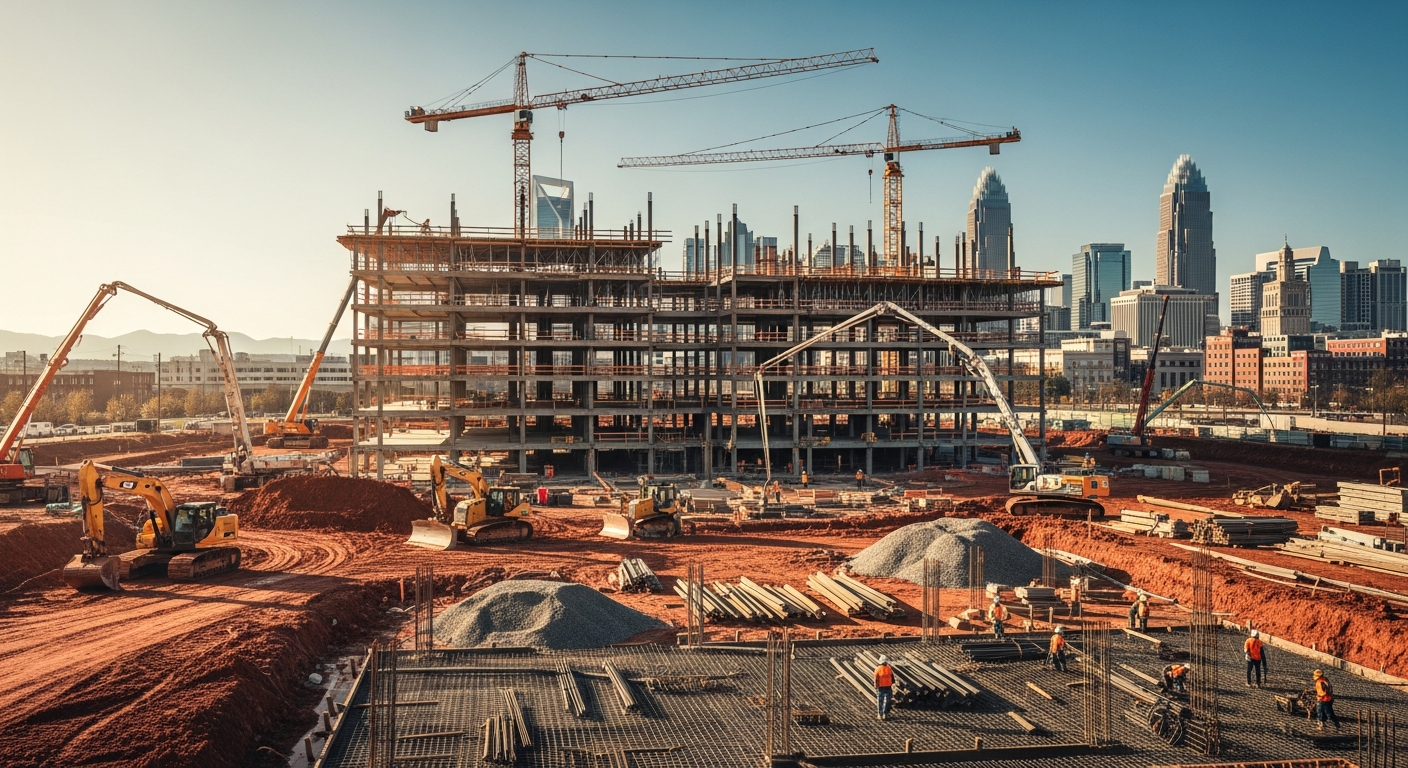
2026 Charlotte Construction Costs Per Square Foot by Building Type
Charlotte construction costs per square foot vary dramatically based on building type, construction quality, and location within the greater Charlotte area. The city's position as a major distribution hub and financial center drives demand across multiple commercial sectors, each with distinct cost characteristics and market dynamics.
Office Building Construction Costs Per Square Foot
Class A office construction in Charlotte's Uptown district and South End ranges from $285 to $425 per square foot in 2026. These projects typically feature high-end finishes, advanced HVAC systems, structured parking, and premium curtain wall systems. Buildings achieving LEED certification add 3-8% to base construction costs, though this premium has decreased as sustainable construction practices become standard.
Class B office buildings in suburban Charlotte locations including Ballantyne, University City, and Northlake command $210 to $295 per square foot. These projects utilize quality materials but employ more cost-effective structural systems and standard mechanical packages. The commercial construction timeline for a typical 40,000-square-foot office building runs 12-16 months from groundbreaking to certificate of occupancy.
Smaller professional office buildings under 15,000 square feet in Matthews, Waxhaw, and similar South Charlotte municipalities cost approximately $195 to $265 per square foot. These structures often serve medical practices, law firms, and professional services requiring moderate finish levels with private offices, conference rooms, and reception areas.
| Office Building Type | Cost Per Square Foot 2026 |
|---|---|
| Class A Office (Uptown/South End) | $285 - $425 |
| Class B Office (Suburban Charlotte) | $210 - $295 |
| Small Professional Office (<15K SF) | $195 - $265 |
| Medical Office Buildout | $135 - $210 |
Retail and Restaurant Construction Costs Per Square Foot
Strip center and retail plaza construction costs in Charlotte range from $165 to $240 per square foot for shell construction, with tenant improvement allowances adding another $35 to $85 per square foot. High-traffic retail corridors along Providence Road, Rea Road, and Highway 51 command premium construction costs due to site development challenges and stringent architectural standards.
Full-service restaurant construction represents one of the most expensive commercial building types per square foot, ranging from $350 to $525 per square foot in Charlotte. This elevated cost reflects the complexity of commercial kitchen requirements, extensive MEP systems, specialized ventilation, grease interceptors, and high-end interior finishes. Our restaurant construction projects in NoDa, Plaza Midwood, and South End consistently demonstrate that kitchen equipment and hood systems alone represent 18-24% of total project costs.
Fast-casual and quick-service restaurant formats cost $280 to $385 per square foot, benefiting from more standardized layouts and less complex kitchen operations. Drive-through facilities add approximately $45,000 to $75,000 to base project costs for ordering systems, window modifications, and site circulation improvements.
Kitchen equipment and ventilation systems typically represent 25-30% of total restaurant construction costs per square foot in Charlotte, with grease interceptors and specialized plumbing adding another 8-12% to baseline commercial construction pricing.
Warehouse and Industrial Construction Costs Per Square Foot
The Charlotte metropolitan area has emerged as a premier distribution and logistics hub, driving significant demand for warehouse and industrial space. Base warehouse shell construction costs $85 to $135 per square foot for conventional tilt-up concrete or pre-engineered metal building systems with 24-30 foot clear heights, standard loading dock configurations, and minimal office space.
Refrigerated and cold storage facilities command premium pricing of $185 to $275 per square foot due to insulated panel systems, specialized refrigeration equipment, and reinforced floor slabs designed to handle forklift traffic and racking systems. The growing food distribution sector in Charlotte, serving both the local market and the broader Southeast, continues to drive demand for these specialized facilities.
Manufacturing facilities with process equipment, specialized power requirements, and heavy floor loading capacity range from $140 to $220 per square foot. Our warehouse construction experience across Steele Creek, west Charlotte, and York County SC demonstrates that site development costs can represent 15-25% of total project budgets for industrial properties requiring extensive utility infrastructure.
Planning a commercial construction project in Charlotte? Get accurate cost estimates based on your specific requirements and site conditions.
Get a Free ConsultationFactors Affecting Charlotte Construction Costs Per Square Foot in 2026
Multiple variables beyond building type significantly impact final construction costs per square foot in Charlotte. Understanding these factors enables more accurate budgeting and helps identify potential cost savings without compromising project quality or functionality.
Site Development and Civil Work Cost Impacts
Charlotte's rolling terrain and clay soils create unique site development challenges that can significantly impact overall project costs per square foot. Grading and earthwork typically costs $8 to $18 per cubic yard depending on haul distances and soil conditions. Projects in established areas of Charlotte often encounter rock requiring blasting or specialized excavation, adding $35 to $65 per cubic yard for rock removal.
Stormwater management requirements have become increasingly stringent under Charlotte-Mecklenburg's updated ordinances. Detention pond construction costs $12 to $22 per cubic foot of storage volume, while underground detention systems utilizing pipe or chamber systems cost $25 to $45 per cubic foot. Properties in Huntersville, Cornelius, and other Lake Norman communities face additional environmental review for projects near water bodies, potentially adding 4-8 weeks to permitting timelines.
Utility extension costs vary dramatically based on existing infrastructure proximity. Water and sewer main extensions cost $185 to $285 per linear foot in Charlotte, while electrical service upgrades to support commercial loads range from $35,000 to $150,000 depending on transformer requirements and distance from existing distribution lines.
Projects in rapidly developing areas of Waxhaw, Weddington, and Indian Land often require significant utility infrastructure investments that can represent 12-18% of total project costs, significantly impacting per-square-foot calculations.
Labor Market Dynamics Affecting Per Square Foot Pricing
Charlotte's construction labor market remains tight in 2026, with unemployment in construction trades below 3.2% regionally. This tight labor market has driven wage increases averaging 4.5-6% annually over the past three years, directly impacting construction costs per square foot. Skilled trades including electricians, HVAC technicians, and plumbers command premium rates, with journeyman electricians earning $32 to $48 per hour and master plumbers $38 to $54 per hour.
Large commercial projects increasingly compete for labor resources, particularly during peak construction seasons from April through October. This competition can extend project timelines by 8-15% compared to off-season construction and may increase labor costs by 6-12% during peak demand periods, directly affecting per-square-foot pricing calculations.
Building Code Requirements and Permit Cost Impacts
Charlotte and surrounding municipalities enforce the 2018 North Carolina Building Code with local amendments, with adoption of the 2024 code cycle expected in late 2026 or early 2027. Current code requirements emphasize energy efficiency, with commercial buildings required to meet stringent thermal envelope and HVAC efficiency standards. These requirements typically add 3-7% to baseline construction costs per square foot compared to minimum code compliance from a decade ago.
Permit and inspection fees in Charlotte are calculated based on project valuation, typically totaling 0.8-1.4% of construction costs for commercial projects. A $2 million commercial renovation project incurs approximately $16,000 to $28,000 in permit fees, plan review charges, and inspection costs. Suburban municipalities including Matthews, Pineville, and Mooresville have similar fee structures.
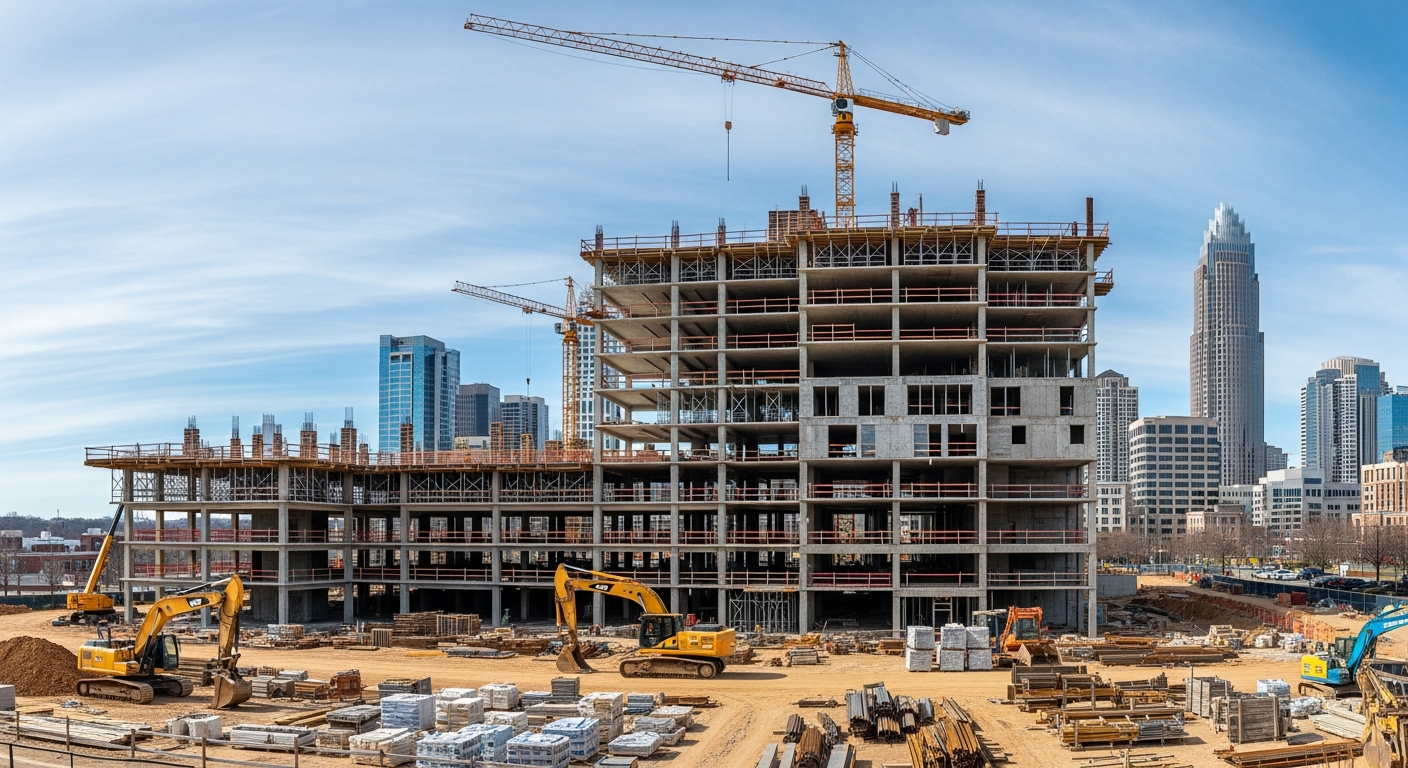
Charlotte Commercial Upfit and Renovation Costs Per Square Foot
Existing building renovations and tenant improvements represent a significant portion of Charlotte's commercial construction activity. Commercial upfit costs per square foot vary significantly based on existing conditions, scope of work, and finish levels required for specific tenant use.
Office Tenant Improvement Costs Per Square Foot
Standard office commercial upfits cost $55 to $95 per square foot for moderate finish levels including new demising walls, carpet or luxury vinyl tile flooring, acoustical ceiling systems, and standard lighting. These projects assume existing HVAC infrastructure adequate for new space layouts with minor modifications to accommodate changed occupancy patterns.
High-end office renovations incorporating glass wall systems, premium finishes, upgraded lighting controls, and enhanced mechanical systems range from $110 to $175 per square foot. Tech companies and financial services firms in South End and Uptown Charlotte frequently invest at this level to create differentiated workplace environments supporting talent recruitment and retention objectives.
Medical office buildouts command premium pricing of $135 to $210 per square foot due to specialized exam room requirements, medical gas systems, lead-lined imaging rooms, and extensive plumbing for clinical functions. Dental office construction typically exceeds these costs at $165 to $245 per square foot when including specialized equipment, sterilization areas, and built-in cabinetry systems.
Step 1: Existing Conditions Assessment
Evaluate existing mechanical, electrical, and structural systems to determine upgrade requirements affecting per-square-foot costs.
Step 2: Space Planning and Design
Develop efficient layouts maximizing usable space while minimizing structural modifications that increase per-square-foot pricing.
Step 3: Systems Integration
Coordinate new tenant requirements with existing building infrastructure to optimize cost-effectiveness.
Step 4: Construction and Installation
Execute upfit construction with minimal disruption to adjacent tenants while maintaining quality standards.
Retail-to-Office Conversion Costs Per Square Foot
Converting retail space to office use has gained popularity in Charlotte as e-commerce pressures reduce demand for certain retail formats while office users seek unique spaces in mixed-use developments. These conversions cost $85 to $155 per square foot depending on the extent of modifications required for HVAC systems, restroom facilities, and exterior access configurations.
Significant cost factors in retail-to-office conversions include upgrading HVAC capacity to handle higher occupancy density typical of office use, reconfiguring storefront glazing to reduce solar heat gain, and adding restroom facilities to meet office occupancy requirements. Projects in historic buildings may encounter additional costs related to preservation requirements and outdated building systems requiring complete replacement.
Brewery and Taproom Construction Costs Per Square Foot
Charlotte's craft brewery scene continues expanding, with brewery construction costs ranging from $245 to $385 per square foot for combination production and taproom facilities. These specialized projects require extensive plumbing for brewing operations, floor drains throughout production areas, high-capacity electrical service for brewing equipment, and specialized HVAC to manage humidity and odors.
Taproom-only concepts without production equipment cost $185 to $265 per square foot, focusing budget on customer-facing spaces, draft systems, and bar equipment rather than production infrastructure. NoDa, South End, and Plaza Midwood remain popular locations for brewery development, with adaptive reuse of existing industrial buildings often providing cost advantages over ground-up construction.
Considering a commercial renovation or tenant improvement in Charlotte? Our team provides transparent cost estimates and value engineering to maximize your construction budget.
Get a Free ConsultationRegional Construction Cost Variations Per Square Foot Across Charlotte Metro
Charlotte construction costs per square foot vary across the metropolitan area's diverse submarkets due to differences in labor availability, material delivery logistics, permit processing efficiency, and site development requirements. Understanding these regional variations enables more accurate budgeting for projects outside Charlotte's urban core.
Lake Norman Region Construction Costs Per Square Foot
Commercial construction in Huntersville, Cornelius, Davidson, and Mooresville typically costs 3-7% less per square foot than comparable Charlotte projects due to lower site development costs and streamlined permitting processes in smaller municipalities. However, specialized trades availability can be limited, potentially extending project timelines by 2-4 weeks for complex mechanical or electrical work requiring Charlotte-based subcontractors.
Projects near Lake Norman itself face stringent environmental regulations protecting water quality, potentially adding 8-15% to site development costs through enhanced stormwater management and erosion control measures. Properties within critical watershed areas face additional restrictions on impervious surface coverage that can constrain site layouts and increase per-square-foot development costs.
Lake Norman Advantages
• 3-7% lower per-square-foot costs
• Streamlined permitting processes
• Larger development sites available
• Lower impact fees in some municipalities
Lake Norman Challenges
• Limited specialized trades availability
• Environmental regulations near water
• Potential timeline extensions
• Watershed development restrictions
South Charlotte and York County Cost Per Square Foot Variations
Ballantyne, Waxhaw, Weddington, and Marvin represent Charlotte's premier southern submarkets, with construction costs per square foot generally tracking Charlotte averages. These areas benefit from excellent trades availability and material supplier proximity while offering larger development sites than urbanized Charlotte neighborhoods.
York County, South Carolina locations including Fort Mill, Rock Hill, and Tega Cay cost 4-9% less per square foot than equivalent Charlotte projects due to lower permitting fees, reduced impact fees, and South Carolina's generally lower prevailing wage rates. However, projects must account for South Carolina building code requirements which differ from North Carolina in specific areas including wind load calculations and fire protection systems.
Eastern Suburbs Construction Cost Per Square Foot Analysis
Matthews, Mint Hill, Indian Trail, and Stallings offer construction costs 2-6% below Charlotte rates per square foot while maintaining excellent access to trades and materials. These established communities provide mature infrastructure reducing site development costs compared to greenfield sites in outlying areas.
The Matthews area has experienced significant commercial development along Highway 51 and Independence Boulevard corridors, creating economies of scale for contractors and suppliers actively working in these markets. This concentration of construction activity has improved subcontractor availability and reduced mobilization costs compared to more isolated project locations.
Building Systems and Their Impact on Charlotte Construction Costs Per Square Foot
Modern commercial construction in Charlotte incorporates increasingly sophisticated building systems to meet energy codes, tenant expectations, and operational efficiency goals. Understanding these systems and their cost implications per square foot helps owners make informed decisions during project planning.
HVAC Systems Cost Per Square Foot Impact
Commercial HVAC systems represent 12-18% of total construction costs per square foot for most building types in Charlotte. Variable refrigerant flow (VRF) systems have gained market share due to energy efficiency and zoning flexibility, costing $18 to $28 per square foot installed for typical office applications. Traditional packaged rooftop units cost $12 to $19 per square foot but may incur higher operating costs over the building lifecycle.
Geothermal heat pump systems cost $24 to $38 per square foot but deliver superior energy efficiency for buildings with moderate heating and cooling loads. These systems work particularly well for small office buildings, churches, and community facilities where long-term ownership justifies higher initial investment through reduced operating costs. Charlotte's mild climate with distinct heating and cooling seasons creates ideal conditions for geothermal system performance.
Roofing Systems Cost Per Square Foot Analysis
Commercial roofing costs vary significantly based on system type and warranty requirements. Thermoplastic polyolefin (TPO) single-ply roofing costs $7.50 to $11.50 per square foot installed, while premium polyvinyl chloride (PVC) systems range from $9.25 to $14.75 per square foot. Built-up roofing (BUR) systems utilizing multiple plies of roofing felt cost $8.50 to $12.25 per square foot and perform well in Charlotte's climate.
Metal standing seam roofing commands premium pricing of $11.50 to $18.50 per square foot but delivers exceptional longevity and requires minimal maintenance. Our roof coating division has observed increased interest in silicone and acrylic coating systems as cost-effective alternatives to complete roof replacement, extending existing roof life by 10-15 years at costs of $3.25 to $5.75 per square foot.
Thermal drone inspections using infrared imaging technology identify moisture intrusion and insulation deficiencies before visible damage occurs, enabling proactive maintenance at minimal cost compared to emergency roof replacements.
Electrical Systems Cost Per Square Foot Considerations
Electrical systems for commercial construction cost $8 to $16 per square foot for basic office applications, increasing to $14 to $26 per square foot for data centers, medical facilities, and manufacturing operations requiring redundant power systems or specialized equipment circuits. Charlotte's electrical codes require arc-fault circuit interrupter (AFCI) protection for certain applications, adding approximately 8-12% to branch circuit costs compared to standard circuit breakers.
Structured cabling and data infrastructure costs $2.50 to $6.50 per square foot depending on density requirements and technology specifications. Modern office buildings typically include Category 6A cabling to support current and future bandwidth requirements, with distributed antenna systems (DAS) for cellular coverage adding $1.75 to $4.25 per square foot in larger buildings where steel construction impedes wireless signals.
Electric vehicle charging infrastructure has become standard for new office construction in Charlotte, with Level 2 charging stations costing $2,500 to $5,500 per parking space including electrical service, conduit, and charging equipment. Buildings pursuing LEED certification often install charging capacity for 3-5% of parking spaces with infrastructure supporting future expansion.
Cost Saving Strategies for Charlotte Construction Per Square Foot Optimization
Strategic planning and informed decision-making during project development can yield substantial reductions in construction costs per square foot without compromising building quality or functionality. Successful commercial projects in Charlotte balance initial construction costs with lifecycle operating expenses and tenant attraction capabilities.
Value Engineering Impact on Per Square Foot Costs
Systematic value engineering during design development typically identifies 8-15% in cost savings per square foot through alternative materials, simplified details, and construction methodology improvements. This process works best when conducted early in design, before construction documents reach 50% completion and design changes become disruptive and expensive to implement.
Alternative exterior cladding systems can yield significant per-square-foot savings while maintaining aesthetic quality. Fiber cement panel systems cost $11 to $19 per square foot installed compared to $18 to $32 per square foot for brick veneer, delivering contemporary appearances popular with technology and creative industry tenants. Insulated metal panels cost $14 to $24 per square foot and provide excellent thermal performance for warehouse and industrial applications.
Strategic Timing Effects on Construction Costs Per Square Foot
Construction timing significantly impacts costs per square foot, with winter months (November through February) offering 6-12% savings on labor-intensive trades due to reduced competition for skilled workers. However, Charlotte's winter weather can impact site work productivity, potentially extending timelines by 2-3 weeks and offsetting some labor savings through extended general conditions costs.
Bidding projects during economic downturns or periods of reduced construction activity can yield substantial per-square-foot savings as contractors sharpen pricing to maintain workforce utilization. However, this strategy requires flexibility in project timing and acceptance of potential delays if market conditions shift during extended planning periods.
Winter construction in Charlotte can reduce labor costs by 6-12% per square foot, but weather delays may offset savings through extended project timelines. Careful scheduling balances cost savings with delivery requirements.
Early Contractor Engagement for Cost Per Square Foot Optimization
Engaging a general contractor during early design phases through construction management or design-build delivery methods typically reduces total project costs by 7-14% per square foot compared to traditional design-bid-build approaches. This early involvement enables constructability reviews, real-time cost feedback, and subcontractor engagement during design development when changes are least expensive to implement.
Preconstruction services including cost estimating, scheduling, and value engineering cost 0.5-1.5% of construction budgets but typically generate returns of 5-10 times this investment through identified savings and avoided design issues. Charlotte's competitive construction market makes this expertise particularly valuable for owners unfamiliar with local market conditions and subcontractor capabilities.
2026 Market Trends Affecting Charlotte Construction Costs Per Square Foot
Charlotte's construction market continues evolving in response to economic conditions, demographic trends, and industry-wide changes affecting material availability, labor costs, and building technology. Understanding these trends helps owners and developers make informed decisions about project timing and budget allocation for construction costs per square foot.
Material Cost Trends Impact on Per Square Foot Pricing
Material costs have largely stabilized in 2026 after significant volatility during 2021-2023, positively impacting construction costs per square foot calculations. Structural steel prices increased 3.2% in 2025 and are projected to rise another 2.8-4.5% in 2026 as domestic production capacity matches demand. Lumber pricing has normalized at levels approximately 18% below 2021 peaks but remains 35% above pre-pandemic averages.
Concrete costs increased 4.8% in Charlotte during 2025 due to higher cement prices and increased demand from commercial and infrastructure projects. Ready-mix concrete currently costs $145 to $165 per cubic yard delivered in Charlotte, with prices expected to rise another 3-5% through 2026 as regional cement production capacity constraints persist.
Supply chain improvements have reduced material lead times to near-historical norms for most building products, enabling more predictable construction costs per square foot. Mechanical equipment including chillers, air handlers, and boilers now ship in 12-16 weeks compared to 26-32 weeks during 2022, enabling more predictable project scheduling and cost control.
"Material availability has dramatically improved since 2022, allowing us to provide more accurate cost estimates per square foot and tighter construction schedules for our Charlotte commercial projects. This predictability helps our clients budget more effectively and plan their business operations around realistic completion dates."
Labor Market Evolution Affecting Per Square Foot Costs
Charlotte's construction workforce continues adapting to industry changes through apprenticeship programs, technology adoption, and productivity improvements, directly impacting construction costs per square foot. Total construction employment in the Charlotte MSA reached 94,500 in early 2026, representing 4.1% growth over 2025 levels. However, this growth lags commercial construction demand, maintaining upward pressure on wages and per-square-foot pricing.
Workforce development initiatives through Central Piedmont Community College and area trade schools are producing approximately 850 new construction trades workers annually in the Charlotte region. While positive, this supply falls short of the estimated 1,200-1,500 annual new workers needed to meet construction demand without wage inflation affecting per-square-foot costs.
Technology Adoption Impact on Construction Costs Per Square Foot
Construction technology adoption has accelerated in Charlotte's commercial construction sector, with building information modeling (BIM) now standard for projects exceeding $3 million in construction value. This technology enables clash detection, quantity takeoffs, and 4D scheduling that reduce field conflicts and change orders by 15-25%, positively impacting final costs per square foot.
Prefabrication and modular construction methods are gaining market share for repetitive building elements including bathrooms, mechanical rooms, and hotel rooms. These approaches can reduce field labor by 20-35% and compress construction schedules by 8-15% while maintaining quality standards, often reducing overall construction costs per square foot through increased efficiency.
Planning Your Charlotte Commercial Construction Project Budget Per Square Foot
Successful commercial construction projects in Charlotte require comprehensive planning, realistic budgeting, and experienced contractor selection. Understanding current construction costs per square foot represents just one element of project success, with schedule management, quality control, and risk mitigation equally critical to achieving project objectives within budget parameters.
Establishing Realistic Construction Budgets Per Square Foot
Commercial construction budgets should include 8-12% contingency for unforeseen conditions, design changes, and market fluctuations affecting per-square-foot costs. This contingency proves particularly important for renovation projects where existing conditions may not fully reveal themselves until demolition exposes concealed building systems and structural elements that can impact final per-square-foot pricing.
Soft costs including architectural and engineering fees (6-10% of construction costs), permitting and testing (2-3%), financing costs, insurance, and owner's project management typically add 18-25% to base construction costs per square foot. Charlotte projects also incur impact fees for water and sewer connections, with costs varying by jurisdiction from $1,800 to $4,200 per equivalent dwelling unit or commercial capacity equivalent.
Professional cost estimating during early project stages provides reliable budget guidance and reduces financial surprises during construction. These services cost 0.3-0.8% of estimated construction value but deliver significant value through identification of potential cost drivers and opportunities for value engineering before design commitment makes changes expensive.
Step 1: Project Scope Definition
Clearly define building requirements, site conditions, and quality expectations to establish accurate per-square-foot cost baselines.
Step 2: Market Research and Benchmarking
Research current Charlotte construction costs per square foot for similar building types and quality levels in your target location.
Step 3: Professional Cost Estimation
Engage qualified estimators to develop detailed budgets including all soft costs and contingencies affecting total project cost per square foot.
Step 4: Value Engineering Review
Evaluate alternative approaches to optimize construction costs per square foot while maintaining functional and aesthetic requirements.
Step 5: Contractor Selection and Pricing
Select qualified contractors with Charlotte market experience and verified track records for similar project types and costs per square foot.
Selecting the Right Contractor for Charlotte Construction Cost Management
Contractor selection dramatically impacts project success and final construction costs per square foot, with experience in specific building types and Charlotte market knowledge providing substantial advantages. Evaluating contractors based on qualifications, references, financial stability, and safety records rather than price alone typically delivers superior project outcomes and more predictable per-square-foot costs.
Charlotte's competitive construction market offers excellent contractor options across all commercial building types. However, specialized projects including cold storage facilities, clean rooms, or historic renovations require contractors with specific experience and subcontractor relationships that generic commercial builders may lack. Verifying contractor licensing, insurance coverage, and bonding capacity before contract execution protects owner interests and ensures contractor financial capability to complete the project within budgeted per-square-foot parameters.
As a veteran and family-owned construction company with over 60 years of combined team experience, We Build brings extensive Charlotte market knowledge and commercial construction expertise to every project. Our membership in the U.S. Green Building Council demonstrates our commitment to sustainable building practices that reduce operating costs while meeting environmental objectives. From ground-up commercial construction to complex tenant improvements, our team delivers quality results on schedule and within budget across Charlotte, Lake Norman, and surrounding communities including Rock Hill SC and the greater Charlotte metropolitan area.
Ready to discuss your Charlotte commercial construction project and get accurate cost-per-square-foot estimates? Call (980) 471-1745 or contact our team today.
Get Your Free Construction ConsultationFrequently Asked Questions About Charlotte Construction Costs Per Square Foot 2026
What are the average construction costs per square foot in Charlotte NC for 2026?
Charlotte construction costs per square foot in 2026 range from $150 to $450 depending on building type. Office buildings cost $195-$425 per square foot, warehouse facilities $85-$275 per square foot, retail construction $165-$240 per square foot, and restaurants $280-$525 per square foot. These costs include basic finishes and standard mechanical systems.
How do Charlotte construction costs per square foot compare to other major Southeast cities?
Charlotte construction costs per square foot are generally 8-15% higher than similar projects in Raleigh, Greensboro, or Columbia SC, but 12-18% lower than Atlanta or Nashville markets. Charlotte's position as a major financial center drives higher material and labor costs compared to smaller Southeast markets while remaining more affordable than established major metropolitan areas.
What factors most significantly impact construction costs per square foot in Charlotte?
Site conditions, building complexity, finish levels, and project timing most significantly impact Charlotte construction costs per square foot. Site development can add 15-25% to base building costs, while high-end finishes increase costs by 20-35% over standard quality levels. Labor availability and seasonal demand fluctuations can affect costs by 6-12% throughout the year.
Are Charlotte construction costs per square foot expected to increase in 2026?
Charlotte construction costs per square foot are projected to increase 4-7% in 2026 based on continued labor shortages, modest material cost inflation, and strong commercial development demand. Steel prices are expected to rise 2.8-4.5%, concrete costs 3-5%, and labor rates 4.5-6% annually, driving overall per-square-foot cost increases throughout 2026.
How much contingency should be included in Charlotte construction budgets per square foot?
Charlotte commercial construction budgets should include 8-12% contingency for new construction and 12-18% for renovation projects. This contingency accounts for unforeseen site conditions, design changes, and material cost fluctuations that can impact final per-square-foot costs. Higher contingencies are recommended for complex projects or tight construction schedules.
What are typical soft costs as a percentage of Charlotte construction costs per square foot?
Soft costs typically represent 18-25% of base construction costs per square foot in Charlotte. This includes architectural and engineering fees (6-10%), permits and testing (2-3%), financing costs, insurance, and project management. Impact fees and utility connections can add another 2-4% depending on project location and municipal requirements.
How do LEED certification requirements affect Charlotte construction costs per square foot?
LEED certification typically adds 3-8% to baseline construction costs per square foot in Charlotte, though this premium has decreased as sustainable construction practices become standard. LEED Gold certification may increase costs by 5-8%, while LEED Platinum can add 8-12% to per-square-foot costs through enhanced energy systems, sustainable materials, and commissioning requirements.
What are the most cost-effective building types per square foot in Charlotte?
Pre-engineered metal buildings and tilt-up concrete warehouse structures offer the most cost-effective construction at $85-$135 per square foot in Charlotte. Standard office buildings provide good value at $195-$265 per square foot, while specialized facilities like restaurants and medical offices command premium pricing due to complex systems and finishes requirements.
Key Takeaways: Charlotte Construction Costs Per Square Foot 2026
- Charlotte construction costs range from $150-$450 per square foot depending on building type, with office buildings averaging $195-$425 and warehouse facilities $85-$275 per square foot
- Site development, labor availability, and building complexity are the primary factors affecting per-square-foot costs in Charlotte's competitive construction market
- Regional variations show Lake Norman area projects cost 3-7% less per square foot while York County SC offers 4-9% savings compared to Charlotte proper
- Soft costs typically add 18-25% to base construction costs, including permits, design fees, and project management expenses
- Construction costs per square foot are projected to increase 4-7% in 2026 due to continued labor shortages and modest material inflation
- Strategic timing, value engineering, and early contractor engagement can reduce per-square-foot costs by 8-15% without compromising quality